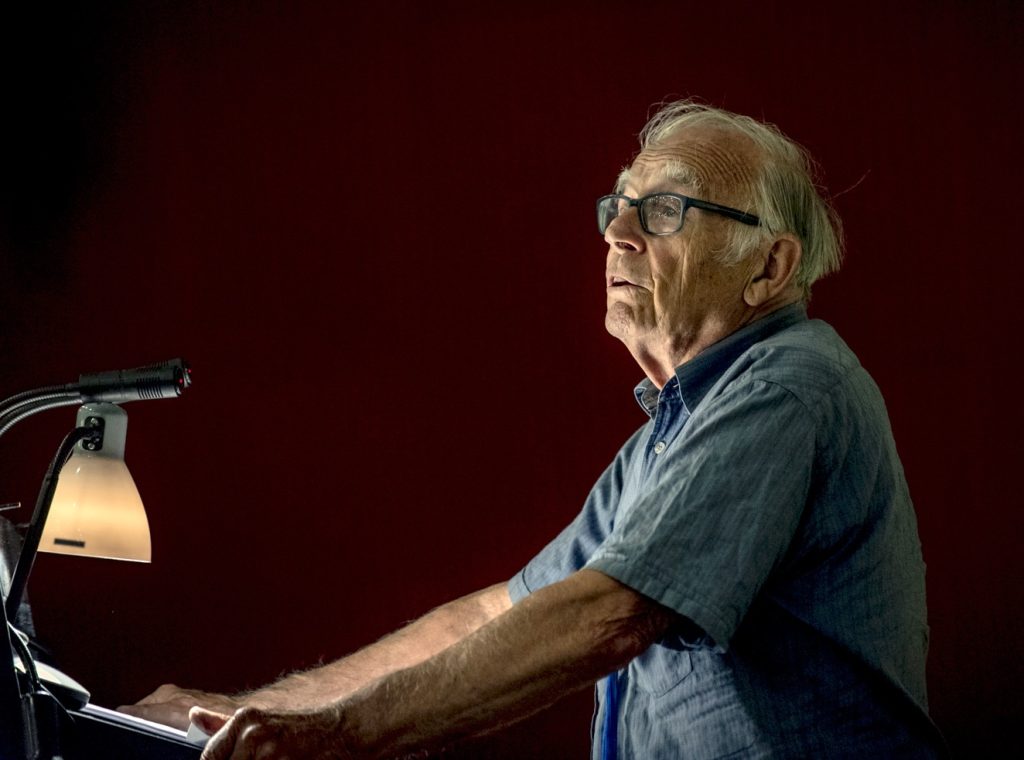
Michael Twyman died in October 2025, at 91, after more that six decades of presence in typographic education. As introductory sentences go, this is an understatement to the point of being misleading. It is inconceivable that “typographic education” as we understand it today would look anything like it does without Michael’s actions. His work shaped a knowledge field, and largely defined the relationship of research and teaching in typography. More so, a lot of research and teaching in areas that Michael rarely or never investigated, happens the way it does because of the intellectual environment and approach to communities of discourse that he fostered.
I will make six points to support this claim.
Michael was undoubtedly lucky in beginning his career at a time of massive expansion in higher education, the transformation of typographic industries through new technologies, and the gradual formalisation of design from craft training into a service profession. These trends were there for all to see — indeed the response of many contemporaries was to publish jeremiads for an audience of like-minded club members, or to attempt to elevate their craft to fussy pedantry (which proved a lucrative line for several in later years). By contrast, Michael’s early approach centred around “Design for reading”: design as a process, within a context, for a purpose that can be interrogated. Designers have agency, but they are constrained by material, social, and intellectual environments: they enable information to be comprehended by readers, within technical and market frameworks. At first — and erroneous — reading, this attitude may be seen to reflect the “design as problem solving” approach that was gaining recognition in the 1960s. But by placing design within multiple contexts, and by surfacing the reader’s perspective as a primary requirement, Michael’s model anticipated the later discourse of “user-centred design”, as well as concerns rooted in broader humanities and social sciences disciplines. (Astonishingly, his 1970 script on Typography as a university study retains undiminished its coherence and validity: but for a sprinkling of updated terms, it could easily serve as the foundation for new courses.)
Not covered in Typography as a university study, but evident from the very early years is another principle in Michael’s pedagogy: that engagement with primary sources is central to understanding why documents take the forms they do, and what meaning they hold for their makers and users. Material properties and the physical, technical, and social conditions of making reveal, explain, and connect. This may seem commonplace now, as many schools hasten to advertise that they arrange visits to archives for their students. However, the experience of examining primary materials at all levels of learning, rather than a privilege for the higher degrees or only established researchers, is a recent development, directly rooted in practice at Reading. Just as important is the guided examination of sets of things, rather than solitary items – this is a fundamental principle for fostering discourse, all the more important as a counter to the narrow scope of digital resources. This is the antithesis of lecturing: it is facilitating a discourse between the learner and the discipline, as it is revealed through the evidence at hand. And it is not extreme to claim that the research activity rewriting the established North-Western and anglo-centric histories can be traced to people trained to look at primary sources. (Indeed, Michael’s regular thematic sessions with materials from his private and the Departmental collections were not only a highlight for students — but a model for enquiry and narrative building that changed the way people thought about the discipline. That model is at the heart of education practice in the Department, and many graduates have transplanted their on interpretations in institutions around the world.)
The focus on primary sources and the attention to sets of objects are best represented by Michael’s championing of the study of ephemera, a field that was marginal until the Department (and, from 1983 onwards, its Centre for Ephemera Studies) provided a home for research into non-book typographic material. The expansion of the researcher’s gaze beyond the “proper” typographic material of learned libraries arguably redefined typographic historiography, and opened the doors to the inclusion of communities of makers and readers that had been absent from mainstream histories. Although the material in the CES overwhelmingly represents British material, the focus on ephemera has had two significant effects: first, of turning the attention of researchers in other regions to material beyond book publishing, thus surfacing typographic histories that colonial ideas of printing had excluded; and secondly, of setting in motion a rebalancing of historiography away from foundry type towards other technologies, including mixed practices. In no uncertain terms there is a direct line between Michael’s first discussions of chromolithography for British ephemera, to his definitive History of chromolithography, to the current boom of research in lithography for scripts beyond Latin — and indeed recent work on woodblock printing.
Michael’s publications (along with those of some other people invariably connected to the Department, notably some texts by James Mosley and the series of Typography Papers volumes) exemplified a mode for discussing diverse material in print: clearly written and richly illustrated texts, the material evidence alongside at scales that support comparisons. This is publishing that is deeply respectful of the readers, allowing them to draw conclusions through critical observation rather than present an authority relying on implicit trust. This approach can be seen throughout Michael’s articles and books across decades, but probably the most impressive is his early Printing 1770–1970, not least for being realised at a time when typesetting such a volume was a feat of planning and execution. (If there is a temptation to see a political positioning in this approach, then this is correct: this is a progressive scholarship, that binds expertise to the duty to explain clearly and empower the reader to draw their own conclusions.)
Most of Michael’s texts — and certainly the ones more frequently cited — fit within the broader field of typographic history. However, in the first half of his career he made significant statements towards a theoretical framework for typography. His exploration of models for describing “verbal graphic language” and the foundation of a robust terminology resonated with emerging theoretical discussions in the late 1970s and 1980s, and got the ball rolling for a number of notable contributions by researchers and staff at Reading. This work preceded the broad acceptance by linguists that “typography matters” (!) and certainly framed both theoretical and empirical research in later years. Regardless of the visibility of this work, it is central to ongoing debates on theoretical aspects of typography, and provides a bridge to adjacent disciplines. From our point of view, is it tempting to see limitations in the monolingual and print context of this work, but this reflects the time it was conducted. It has informed extensions into digital and multilingual/multiscriptal environments, and is still a key reference framework for the discourse on forming a typographic knowledge discipline.
My last point relates to the sense of place: the foundation of a community in a campus-based, research-intensive university. Since the 1970s the Department of Typography & Graphic Communication‘s modest building provides a flexible environment where primary and secondary sources are available alongside spaces for study and work. The building exemplifies a flat hierarchy between students, staff, and resources, a deeply integrated learning environment melding studio culture and research institute. The Department that Michael founded is a living laboratory for a transformative (and now provocatively anachronistic) model of working and learning. Its success is evident not just in the work carried out on site, but in the global network of graduates who absorb its fundamental principles and make them their own, shaping new spaces for research and learning. Thus his legacy: a community and a discipline that continue to grow and redefine the scope of their purpose.